
Do These GBP Reviews Come From Local Customers?
A method for testing whether a Google Business Profile’s reviews reflect its stated market — worked on a real Las Vegas listing with 660 reviews and a 5.0 rating
A garage door company in Las Vegas has a Google Business Profile with 660 reviews and a displayed 5.0 rating. On the surface, that’s a dominant local business. But a rating is only as meaningful as the customers behind it, and “660 reviews” tells you nothing about where those customers are.
So I asked a narrow, answerable question: do the reviews on this profile actually come from Las Vegas customers?
This is a question that comes up constantly — for a competitor weighing whether a rival’s dominance is real, for a franchise brand checking whether a location is playing by the rules, for anyone doing diligence on a local-services business. It’s also answerable entirely from public data, if you know where to look. This is how I answered it, what I found, and — just as important — what I deliberately did not conclude.
The subject is A Plus Garage Door Repair, 3272 E Sunset Rd #150, Las Vegas, NV 89120. I’m naming the business because everything below rests on public records anyone can re-check, and because I’m not accusing anyone of anything — I’m reporting indicators and leaving intent where it belongs. Where the evidence involves individual reviewers or named employees, I’ve redacted them: they are private people who may themselves be victims here, and their identity isn’t the point. The photo match is. (All figures below are as captured in July 2026; a live profile will have moved since.)
First, why the rating tells you nothing
Start with the obvious surface metric — the 5.0 rating — and watch it fail immediately.
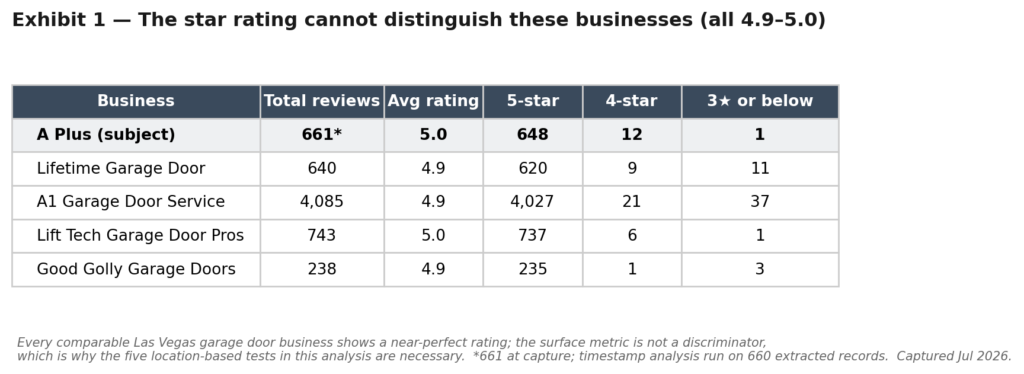
Every comparable Las Vegas garage door business sits at 4.9 or 5.0. One competitor shows 737 of 743 reviews at five stars — a rating as clean as the subject’s. The star rating simply cannot distinguish these businesses from one another. That’s not a quirk; it’s the whole reason the rest of this analysis exists. If the rating could answer the question, you wouldn’t need the five tests below. It can’t, so here they are.
The five things I checked
No single test proves much on its own. The point is convergence: when several methods, drawing on different data, all point the same direction, the picture gets hard to explain away.
1. Where do the reviewers actually live?
Every Google reviewer has a public contributor profile listing the other businesses they’ve reviewed. Those businesses have locations. If someone has reviewed a dentist in Provo, a restaurant in Orem, and a gym in Sandy, it’s reasonable to infer that reviewer is based in Utah — not Las Vegas.
I opened the contributor profile for 228 of the subject’s reviewers and tabulated the state of every business each had reviewed. A reviewer was classified “Utah-dominant” if at least half of their geographically identifiable reviews were of Utah businesses, with a minimum of three identifiable reviews. (This is why geography used a 228-reviewer sample rather than the full set: each profile had to be opened and its review history read and classified by hand. The cross-location test in Finding 3, by contrast, only required matching a reviewer ID, so it could be run across all 660.)
I then ran the identical procedure on four comparison businesses, selected as the four highest-review-count results for “garage door repair Las Vegas” in the Las Vegas metro, as searched July 21, 2026 (640; 4,085; 743; and 238 reviews). They serve as a control: what does normal reviewer geography look like for a real Las Vegas garage door company?
The result:
79% of the subject’s reviewers (180 of 228) were Utah-dominant. Across 160 reviewers sampled from the four comparison businesses, not one was — a rate of 0 of 160, with an upper 95% bound of roughly 2%.
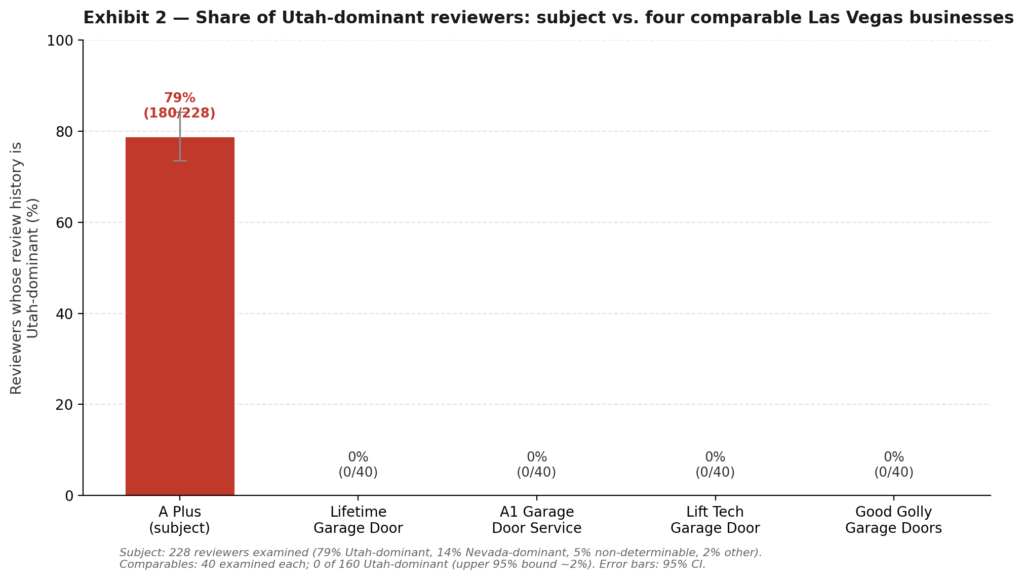
Only 14% of the subject’s reviewers looked Nevada-based. For a Las Vegas business, that’s backwards — and the four local competitors show what normal looks like: their reviewers are overwhelmingly local, and none skew to Utah. The control group is what turns this from an impression into a finding. Out-of-state reviewers exist everywhere; the question is always how many, compared to normal. Here, the answer is far more than normal, concentrated in one specific state.
Which state matters, as we’ll see.
2. When did the reviews arrive?
I extracted the timestamp of all 660 reviews and plotted them by month.
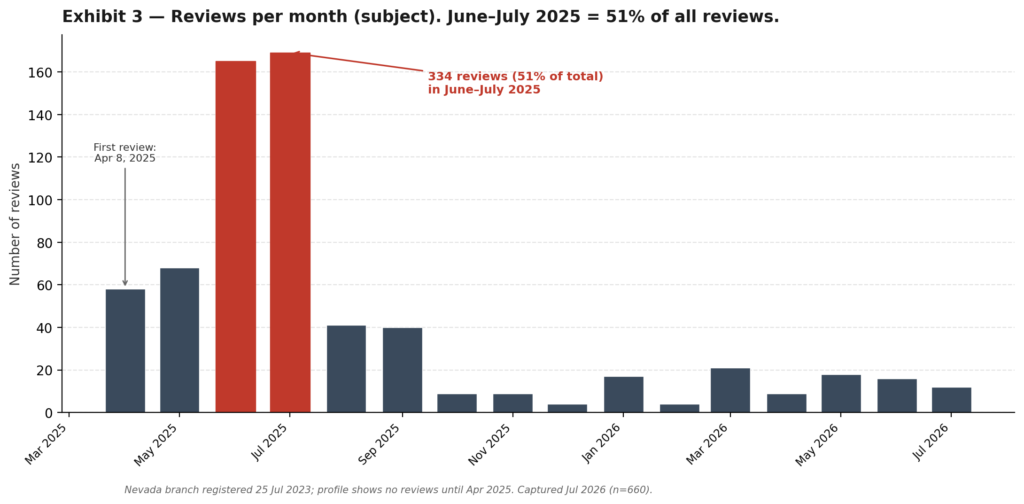
The profile shows no reviews at all before April 8, 2025. Then, over four months, it added 460. 334 of them — 51% of the profile’s entire history — landed in the two-month window of June and July 2025. After that, volume collapsed to a trickle and has stayed there.
I’ll be direct about the limits of this one. The Nevada branch was registered in July 2023, yet the profile shows no reviews until April 2025. What the listing’s status was in that gap — whether it existed, was unverified, or was created later — I could not determine from public data. So I don’t treat the earlier silence as an indicator. And there’s an innocent reading of the spike itself: a company activating a profile and asking its existing customers for reviews would produce a burst. The shape is consistent with a concentrated seeding effort, but on its own it doesn’t distinguish that from a legitimate launch campaign. It’s context for the other findings, not a pillar.
3. Do the same reviewers appear on other locations?
A Plus operates a large network of location-branded profiles: its Utah parent entity registers at least ten Utah-city trade names in state corporate records (see Finding 5), and it maintains a comparable set of location profiles across the Mountain West. Across all 660 subject reviewers, I checked how many had also reviewed other A Plus locations.
68 reviewer accounts had reviewed more than one A Plus profile. With a network this size, some overlap is expected — so the raw count isn’t the story. The concentration is:
One of the four comparison businesses (A1, 4,085 reviews) is itself multi-location, so I ran the same overlap test on it as a baseline. The result is instructive: 12 of 100 sampled A1 reviewers had also reviewed another A1 profile — a rate (12%) close to A Plus’s 10.3%. So multi-location overlap, on its own, is normal. That isn’t the finding.
The finding is the shape of the overlap. All twelve of A1’s overlapping reviewers reviewed two profiles that are both in Las Vegas — a local customer reviewing two local branches, exactly what you’d expect. And A1’s overlap stops at two: none of the twelve touched a third profile. A Plus’s overlap does neither. Its overlapping accounts span Reno, Henderson, and Las Vegas, Nevada, plus multiple Utah cities — and the tail runs far deeper. Of the 68, sixty-five reviewed two profiles, two reviewed three, and one had reviewed eight distinct A Plus locations across two states (so three accounts touched three or more profiles, versus zero for A1):
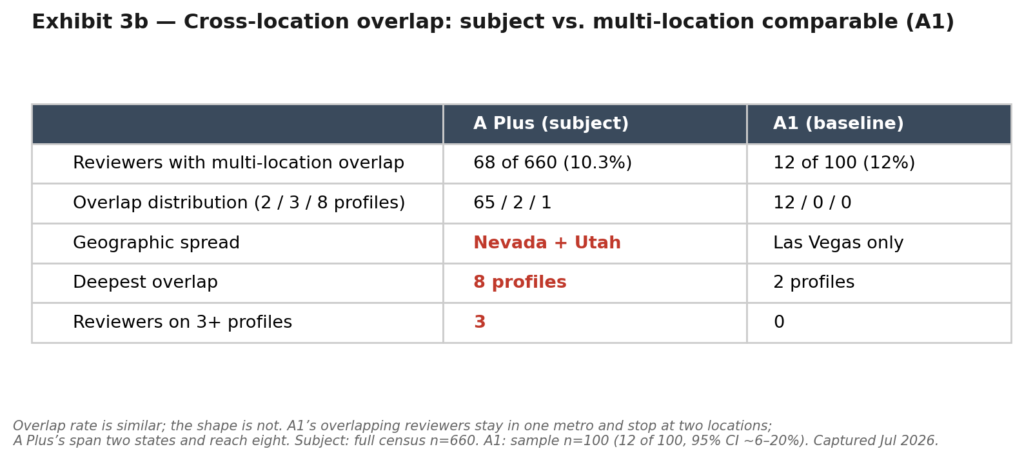
Here’s the part that resists an innocent reading. Yes, landlords, property managers, and contractors hire garage door companies repeatedly and legitimately — two or three locations wouldn’t raise an eyebrow. But this account’s eight A Plus reviews span Reno, Las Vegas, and Henderson, Nevada, plus Lindon, Provo, and Payson, Utah — and its other reviews are a VR arcade and a paintball park in Utah County. That is not the footprint of a multi-state property owner. It’s a Utah-based account leaving five-star reviews for A Plus locations across two states.
4. Do the review photos hold up?
This is the test that needs no statistics at all.
I ran all 206 photos attached to reviews on the profile through reverse-image search and perceptual hashing — a technique that identifies the same image even after resizing or recompression. Two of them traced back to businesses with no connection to A Plus.
Photo one, attached to a five-star review dated May 14, 2025:
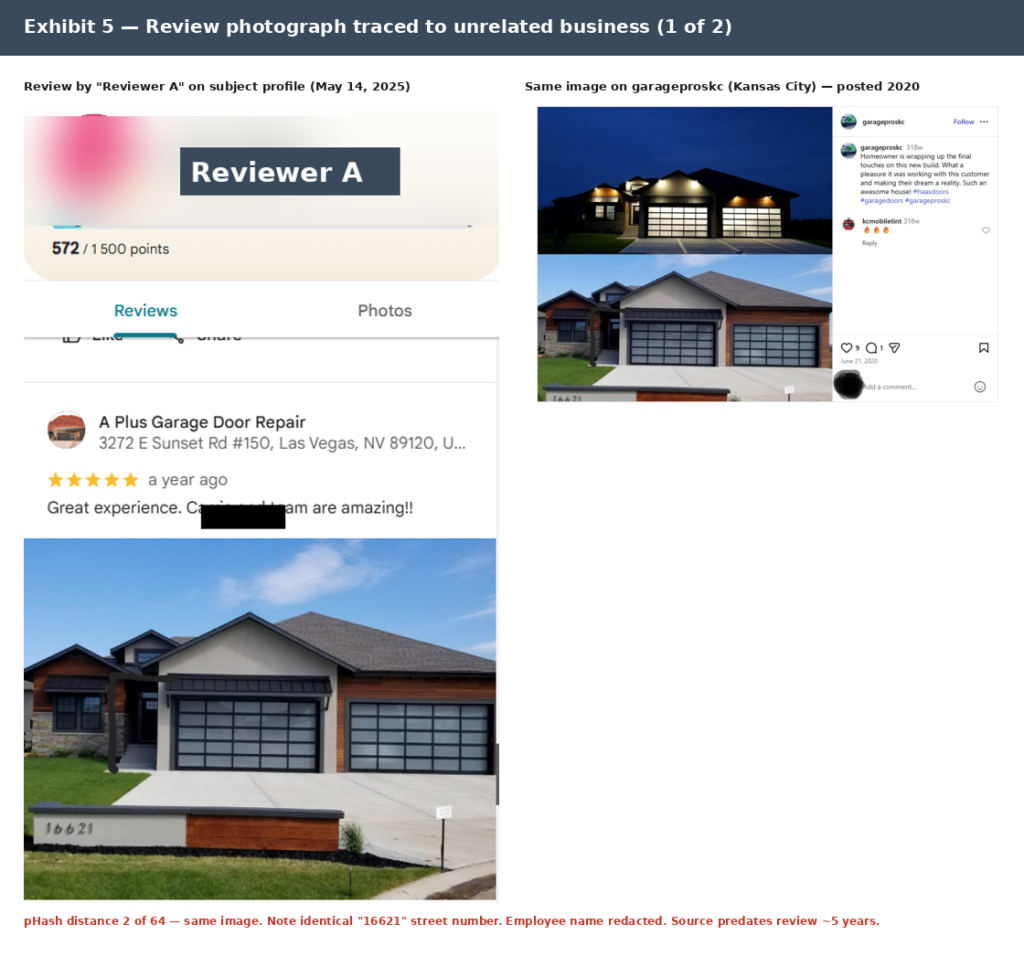
The same image — down to the “16621” street number on the retaining wall — appears on the Instagram of a garage door company in Kansas City, posted in 2020, describing their customer’s build. pHash distance: 2 of 64 — the same image. It predates the Las Vegas review by about five years.
Photo two, attached to a five-star review dated July 1, 2025:
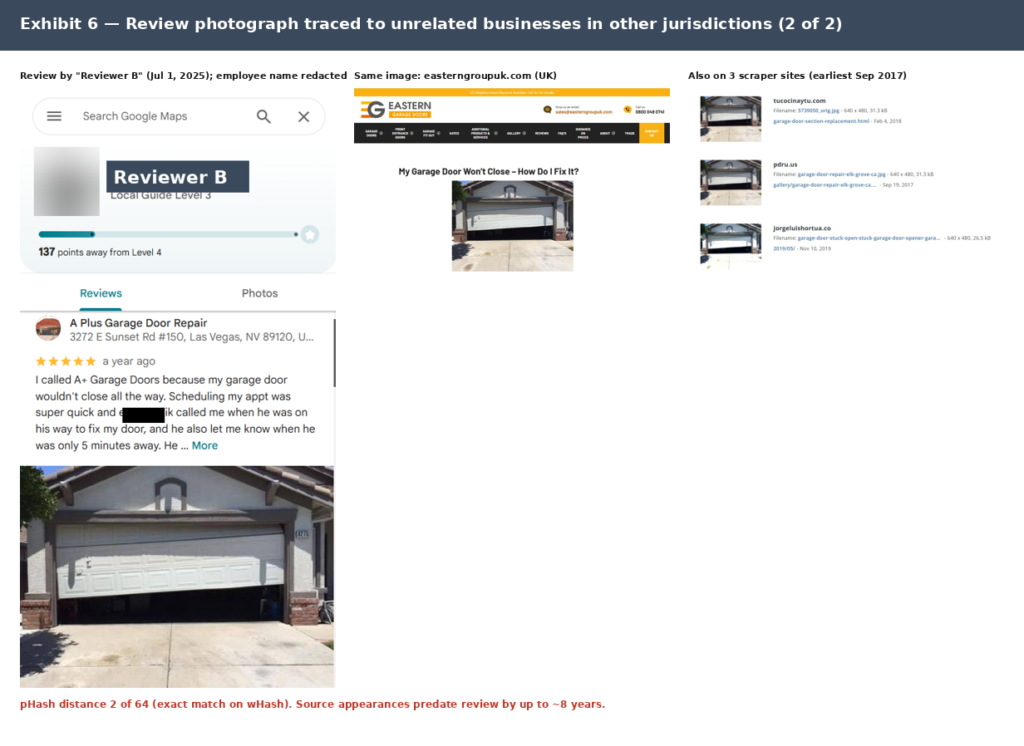
The same image appears on the website of a garage door company in the United Kingdom (easterngroupuk.com, on a page titled “My Garage Door Won’t Close – How Do I Fix It?”), and on three additional unrelated content-scraper sites, the earliest dated September 2017. pHash distance: 2 of 64, with an exact match on a second hashing algorithm. The earliest source predates the review by nearly eight years.
A photograph that lives on a Kansas City company’s Instagram, or a British company’s website, years before a Las Vegas review was posted, could not have been taken at that Las Vegas job. Whatever these two reviews are, they are not a customer documenting work done on their home.
5. Who actually owns this?
The corporate records tie it together. A Plus Garage Doors, LLC is a Utah company. Its registered trade names read like a tour of Utah’s Wasatch corridor: Cottonwood Heights, West Jordan, Salt Lake City, Herriman, Layton, Ogden, Roy, Orem, Bountiful, and more. The Las Vegas operation is registered in Nevada as a foreign LLC — a branch of the Utah company — filed July 25, 2023.
So the Las Vegas listing and the Utah operation are the same legal entity. That’s the context for findings 1 and 3: the reviewers concentrated in Utah, and the accounts spanning multiple locations, are consistent with one Utah-based operation whose reviews are not tied to any single location’s actual customers.
The honest part: what this doesn’t prove
Here’s where most “gotcha” write-ups overreach, and where I won’t.
There’s a legitimate innocent explanation for much of this. A Utah company expands to Las Vegas, activates its profile, and asks its existing Utah customers to leave reviews. That single story could explain the Utah-heavy reviewers (finding 1), the sudden spike when the profile went live (finding 2), and some of the cross-location overlap (finding 3). Aggressive review-gathering isn’t the same as fabrication, and I won’t pretend it is.
But that explanation runs into a wall at finding 4. A review-request campaign aimed at real customers does not produce reviews carrying photographs lifted from a Kansas City company’s Instagram and a British company’s website. Those two reviews did not come from customers describing A Plus’s work — the images make that impossible. That’s the part no innocent story accounts for.
And here is what I am explicitly not claiming:
- I am not stating who wrote any of these reviews.
- I am not stating that A Plus, its owners, or its employees created, bought, or directed any review.
- I am not stating any review is false as to the underlying service.
- I am not stating any law or platform policy was broken.
- I am not commenting on the quality of the company’s work.
Those are determinations for a platform, a regulator, or a court — people with subpoena power and access to information I don’t have. My work stops at the observable evidence. What that evidence supports is a single, carefully bounded statement:
The reviews on this Las Vegas profile show multiple independent indicators inconsistent with reviews originating from Las Vegas customers.
That’s it. That’s the finding. Everything past it is someone else’s call.
Trust the Method, Not the Messenger
Every method above is reproducible. The contributor profiles are public. The corporate filings are public. The review timestamps are public. The photos are still live, and anyone can run the same reverse-image search I did. A skeptic who thinks I’m wrong can re-run every step and check my work — which is exactly the standard evidence should meet.
That’s the difference between an accusation and an analysis. An accusation asks you to trust the accuser. An analysis hands you the method and the sources and invites you to disagree.
If you’re evaluating a competitor, a franchisee, an acquisition target, or an opponent, and the surface metrics don’t sit right, this is the kind of question worth asking — and the kind of evidence worth having before anyone makes a decision or a claim.
This analysis was conducted entirely from public sources, captured July 2026. All materials — screenshots, extracted data, corporate records, and image-hash results — were preserved with timestamps and cryptographic hashes and are retained in the case file. A specimen of the declaration format this methodology produces is available on request.
Plumbline Intelligence — forensic competitive intelligence for high-stakes decisions.