
What a Backlink Profile Hides: A Forensic Read of a Sold Flippa Asset
Listing: Flippa – sold for USD $13,338 (1.8x profit / 1.7x revenue)
Methodology: SEO forensics + OSINT, two independent sources per central claim
Executive Summary
This is a retrospective acquisition-diligence review of canadiandebtrelief.ca, a Canadian debt-relief lead-generation site that sold on Flippa for USD $13,338 at a stated 1.8x profit / 1.7x revenue multiple. The listing presented the asset as a two-year-old content site earning roughly $10.4K/year at 99% margin, with strong authority signals and “119.5K AI mentions.” The question this investigation set out to answer was simple: does the asset’s authority and traffic profile justify the claims made in the listing, or is the authority manufactured?
The evidence points clearly to the latter. Three findings, each independently sourced, define the asset:
- The authority was manufactured immediately before sale. The site’s referring domains rose roughly six-fold – from ~51 to 329 – almost entirely within the eight weeks around the listing (May–June 2026). Of 329 referring domains, 278 (85%) first appeared in that window; 97% are flagged as spam by Ahrefs, 96% have no organic traffic, and the cluster is dominated by link-farm TLDs. Several referring domains resolve to a self-described commercial private-blog-network vendor advertising links for sale.
- The manufactured authority produced no ranking benefit whatsoever. Despite the link spike, organic traffic sits at roughly 9 visits per month. Of 1,000 ranking keywords, 852 sit on page six or beyond; only three keywords drive any traffic at all – and those three are payday-loan brand terms, not debt-relief terms, contradicting the site’s stated purpose.
- The headline claims do not survive contact with the data. The “two-year-old site” is a re-registered domain with twelve-plus years of prior, unrelated history. The “119.5K AI mentions” claim is not reflected in any measurable AI-visibility dataset. The “$10.4K/yr” revenue is contradicted by the seller’s own financial statistics inside the same listing (which sum to ~$7,634). And the seller’s reported analytics – 43,200 users – cannot be reconciled with independent tools, which see roughly nine organic visits per month.
Taken together, the assets were cosmetically prepared for sale. Its only plausible residual value is an existing contact list a buyer cannot verify before purchase, which reframes the entire transaction as buying an unverifiable mailing list at a content-site multiple. None of this is visible from the listing, the marketplace’s “Verified” badge, or a surface-level tool check – the verification confirms the seller’s reported numbers exist; it does not test whether the authority or traffic behind them is genuine. That gap is precisely what buy-side diligence exists to close.
Why the size of this deal is not the point. This asset sold for $13,338, and on a deal that small a $7,500 diligence engagement would not pencil out. But the pattern documented here – manufactured authority, irreconcilable analytics, claims that fail verification – is identical on a $150,000 aggregator acquisition, where it is a six-figure mistake. Against that downside, the cost of diligence is a rounding error. The lesson scales; the asset is just the specimen.
Claims Verification Summary
Every claim made in the listing, tested against independent evidence. Verdict vocabulary: Verified / Contradicted / Misleading / Unverified / Unable to determine.
Part A — Claims made in the listing
| # | Claim | Verdict | Confidence | What the evidence shows | Evidence |
|---|---|---|---|---|---|
| 1 | $10.4K/yr revenue | Contradicted | High | Contradicted by the seller’s own Financial Statistics in the same listing: annual revenue shown as $7,634 (monthly breakdown sums to ~$7,632), not $10.4K. The listing card and the listing’s own dashboard disagree. | Flippa Financial Statistics + monthly breakdown |
| 2 | 99% profit (hosting-only) | Unverified | Low | Plausible for a thin lead-gen site; no cost data available to a buyer to confirm. | Flippa card |
| 3 | $628/mo net profit | Contradicted | Moderate | Arithmetic conflict on the card itself: $628 × 12 = $7,536, not the $10.4K/yr also claimed. | Flippa card |
| 4 | 2-year site age | Misleading | High | Current registration is ~2yr (created 2024-02-03), so literally true — but the domain hosted debt-relief content since 2012 and a lead-gen funnel through 2021, then went dark and was re-registered. Sold as a clean 2-year build while carrying 12+ years of inherited domain history. | Wayback (2012/2021/2024); WHOIS |
| 5 | 119.5K “AI mentions” | Contradicted | High | SEMrush AI Visibility = 0 and AI Mentions = 0 across ChatGPT, AI Overview, AI Mode, and Gemini. The site’s robots.txt also blocks major AI crawlers. Not reflected in any measurable dataset. | SEMrush overview; robots.txt |
| 6 | 1.7K contacts | Unverified | Low | A lead-capture stack exists (HubSpot + Brevo; dedicated form subdomain), so a list is plausible. The count is not externally verifiable. | web-check; form subdomain |
| 7 | Partner deals | Unverified | Low | Lead-gen + affiliate mechanisms confirmed (affiliate redirect resolves to a finance CPL network). Specific partner contracts not externally evidenced. | cmi.rocks → CreditMarketing.ca |
| 8 | Verified Listing (badge) | Verified | High | The marketplace verifies the seller’s connected traffic/revenue data. It does not test backlink quality or authority origin — the gap this report fills. | Flippa badge |
| 9 | 1.8x / 1.7x multiple | Unverified | Low | Rests entirely on the revenue/profit inputs in rows 1–3, which do not reconcile and are unconfirmed. | Flippa card |
| 10 | Editor’s Choice (badge) | Unverified | High | Editorial/marketing label, not a financial or quality signal. No diligence weight. | Flippa badge |
Part B — Findings from the investigation
| # | Investigation question | Verdict | Confidence | What the evidence shows | Evidence |
|---|---|---|---|---|---|
| F1 | Is the link authority earned? | Contradicted | High | 85% of referring domains appeared in the listing window; 97% spam-flagged, 96% zero-traffic, link-farm TLDs. Several resolve to a self-described PBN vendor. | Ahrefs export + domain screenshots |
| F2 | Did the authority produce ranking benefit? | Contradicted | High | No. ~9 organic visits/mo; 852/1000 keywords at position 51–100; only 3 keywords drive traffic. | SEMrush positions CSV + overview |
| F3 | Does it rank for its stated purpose? | Contradicted | High | The only traffic-driving keywords are payday-loan brand terms, not debt-relief terms. | SEMrush top pages |
| F4 | What is the real revenue model? | Misleading label | Moderate | Primary = lead generation (own form, sitewide). Secondary = occasional affiliate (finance CPL network). “Affiliate Sales” label understates the lead-gen engine. | On-page link inspection |
| F5 | Is the authorial expertise real? | Unable to determine | Moderate | Named principal/author personas (“Marcus Chan,” “Evelyn”) could not be corroborated by any independent source; reverse image search inconclusive. | TinEye; on-page |
| F6 | Do the seller’s analytics reconcile? | Contradicted | High | Seller GA shows 43,200 users / 56,422 page views (71% organic). Independent tools show ~9 organic visits/mo. The figures cannot be reconciled; reported engagement (0.46% rate, 56s sessions, 1.08 pp/session) is a data-integrity flag. | Flippa Engagement stats vs SEMrush |
Methodology
This investigation followed Plumbline’s standard acquisition-diligence sequence. Every central claim was tested against at least two independent sources. Findings are stated with explicit confidence levels (high/moderate/low), speculation is labelled as such, and what could not be determined is documented rather than glossed.
Tools and sources used:
- Ahrefs – referring-domain inventory, first-seen dates, spam classification, DR trajectory
- SEMrush – organic traffic, keyword positions, AI-visibility data, authority score (independent cross-check of Ahrefs)
- Internet Archive (Wayback Machine) – domain history and prior incarnations
- WHOIS / web-check.xyz – registration, hosting, DNS, mail and lead-capture stack
- Direct on-page inspection – outbound link structure, monetization mechanism, redirect resolution, author/persona checks
- TinEye reverse image search – author photo corroboration
Scope boundary: this is a retrospective review of a sold listing, conducted from open sources only. No privileged seller data was accessed. Where open sources reach their limit – notably registrant identity behind CIRA privacy and the identity of whoever deployed the links – that limit is stated plainly.
Finding 1: The “Two-Year-Old Site” Is a Re-Registered Aged Domain
Verdict: Misleading. [High confidence]
The listing describes a two-year-old site. The current registration is indeed recent – the domain was created 2024-02-03 – so the claim is literally true. The Internet Archive, however, shows the domain has been in continuous debt-relief use since 2012, across at least two prior incarnations:
- 2012 – a debt-relief blog (bylined “Susan D”), informational in nature.
- Through Dec 2021 – an active debt-relief lead-generation funnel (“Eliminate debt and get your life back”, debt-level qualifier widget).
- 2022–2023 – no archived captures; consistent with the domain lapsing.
- Feb 2024 onward – the current build (fresh WordPress/PageBolt theme, ©2023), first archived 2024-02-27, weeks after re-registration.
The implication for a buyer is not trivial. A 1.8x-multiple paid for a “two-year-old site” partly buys aged-domain equity and inherited backlinks accumulated over twelve-plus years by prior, unrelated owners – authority the current operator did not earn through the present site’s content. Whether the current operator is continuous with prior owners or acquired a lapsed domain could not be established (CIRA registrant privacy; prior captures expose no matching identity). Either interpretation leaves the “two-year-old site” framing materially misleading.

Figure 1. canadiandebtrelief.ca homepage (current build). The asset as presented to buyers.
How this was caught: the domain’s WHOIS creation date (2024-02-03) was cross-referenced against its Internet Archive history, which shows debt-relief content back to 2012. A “site age” figure that matches the registration but not the archive is the tell.
Finding 2: The Authority Was Manufactured in the Listing Window
A note on framing before the evidence: this section establishes that the link profile is manufactured and that it appeared during the listing window. It does not, and cannot from open sources, establish who created or commissioned those links. The finding is stated at the confidence the evidence earns, and the question of responsibility is left open.
Verdict: Contradicted (authority is not earned). [High confidence]
Referring-domain growth was flat for the life of the current site, then rose roughly six-fold in a single two-month window aligned with the sale listing:
| Period | New referring domains | Note |
|---|---|---|
| Site life through Apr 2026 | 51 (cumulative) | Slow inherited/organic baseline |
| May 2026 | 206 | Onset of spike |
| June 2026 (to export) | 72 | Spike continues |
| Total at export | 329 | ~6x prior baseline |
Source: Ahrefs referring-domains export, 25 June 2026.
Characterization of the 278 spike-window domains
- 270 of 278 (97%) are flagged as spam by Ahrefs’ own classifier.
- 266 of 278 (96%) have zero estimated organic traffic – the linking sites have no audience of their own.
- The set is dominated by bulk-registered link-farm TLDs: 109 .store and 58 .shop domains – 167 of 278 – on a Canadian consumer-finance site.
- Clusters share link-vendor naming and near-identical first-seen dates, the signature of a coordinated deployment rather than organic acquisition.
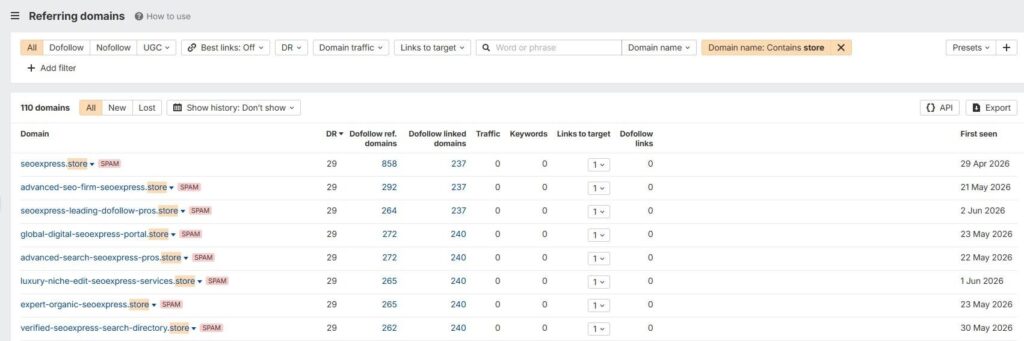
Figure 2. Ahrefs view filtered to “.store” referring domains – 110 results, every one SPAM-flagged, all first-seen May–June 2026, all zero traffic. Note the vendor-style naming (“advanced-seo-firm-”, “expert-organic-”, “verified-…-directory”).
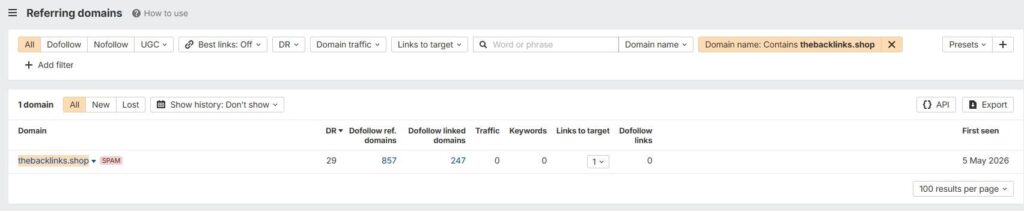
Figure 3. A representative SEO-vendor .shop domain (thebacklinks.shop): DR 29, zero traffic, SPAM-flagged, first seen 5 May 2026.
The referring domains are, in several cases, link products for sale
This is not an inference about whether the links look paid. One cluster of referring domains resolves to a storefront that openly advertises a commercial private blog network:
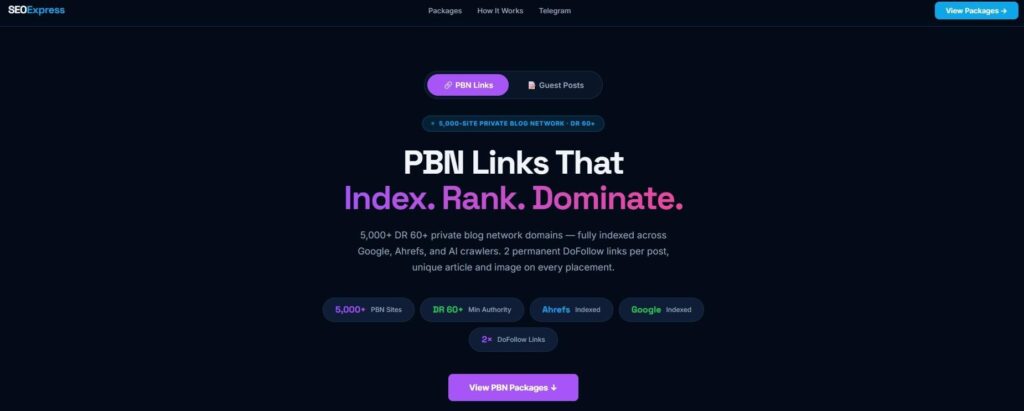
Figure 4. One spike-window referring domain (theseohighranking.shop) resolves to “SEOExpress” — a self-described 5,000-site PBN advertising “PBN Links That Index. Rank. Dominate,” “Ahrefs Indexed,” “Google Indexed,” 2× DoFollow links per post. The referring domains are link inventory sold commercially.
A second cluster takes the form of generic “blog” domains with inflated Domain Rating and no audience. The mechanism behind the inflated DR is visible in the data: blogpayz.com shows DR 51 while linking out to 218,943 domains – a profile inconsistent with a genuine blog and consistent with a link-network node.

Figure 5. blogpayz.com in Ahrefs: DR 51, SPAM-flagged, zero traffic, first seen 6 May 2026 – but linking out to 218,943 domains, the hallmark of a network node rather than a real blog.

Figure 6. The same domain rendered: a generic “create your own website for free” template, unrelated to Canadian debt relief.
The same pattern repeats across the cluster. worldblogged.com (DR 46, zero traffic, first seen 6 May 2026) links out to 199,874 domains – a second network node identical in profile to the first.
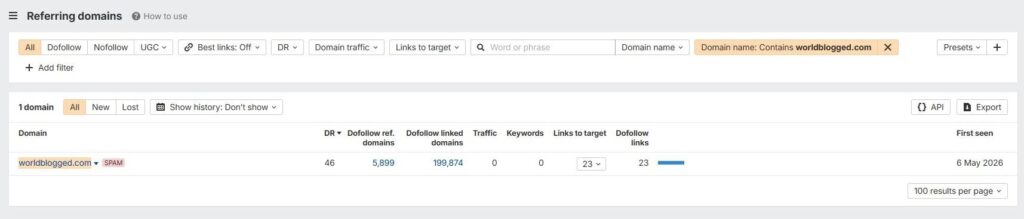
Figure 7. worldblogged.com – a second “blog” node: DR 46, zero traffic, SPAM-flagged, 199,874 outbound linked domains, first seen 6 May 2026.
The few genuine referring domains, named for completeness
Not every referring domain is manufactured, and a credible read must say so. A small number predate the spike and show real traffic – for example lotly.com (DR 18, ~22K traffic, first seen Jan 2025) and rkillen.ca (DR 12, ~203 traffic, first seen Dec 2025). These are excluded from the manufactured-link count and are noted here so the 97%-spam finding is understood as a measured figure, not a blanket characterization.
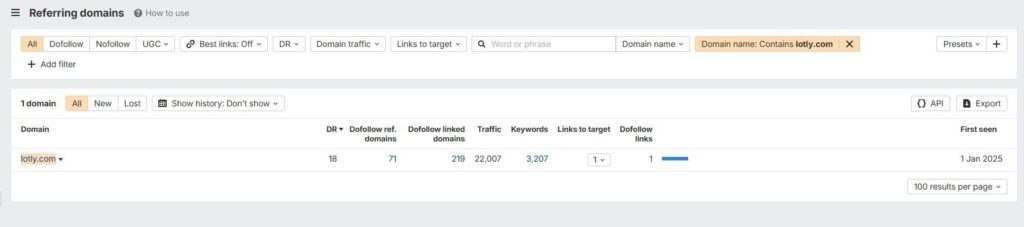
Figure 8. lotly.com – a genuine referring domain (real traffic, pre-spike), excluded from the manufactured-link bucket.
How this was caught: each referring domain’s first-seen date was cross-referenced against the listing window, then the cluster was characterized by spam flag, organic traffic, TLD and outbound-link volume. A six-fold spike concentrated in the eight weeks around a sale, composed of zero-traffic link-farm domains, does not occur organically.
Finding 3: The Manufactured Authority Produced No Ranking Benefit
Verdict: Contradicted. [High confidence]
This is the decisive contrast. The referring domains increased six-fold; the site’s actual search performance did not move. Independent SEMrush data (a separate source from the Ahrefs link data) shows an asset with effectively no organic presence:
- Authority Score: 12 (“poor traffic”) – despite 277 referring domains. Real authority and referring-domain count move together; here they are divorced, which is itself the manufactured-authority signature.
- Organic traffic: ~9 visits per month, total, across the entire site.
- 1,000 ranking keywords, but 852 sit at position 51–100 – page six or beyond, where no clicks occur. Only three keywords drive any traffic at all (a combined nine visits).
- AI Visibility: 0; AI Mentions: 0 across ChatGPT, AI Overview, AI Mode and Gemini – directly contradicting the listing’s “119.5K AI mentions.”
In other words, the manufactured links bought a cosmetic referring-domain count and an inflated DR, and nothing else. They did not move rankings, traffic, or AI visibility. For a buyer, this inverts the asset’s value: the backlink profile is not an authority asset but a standing liability (see Finding 5).
The site does not rank for its stated purpose
The three keywords that drive the site’s entire organic footprint are payday-loan brand terms – “loanmenow,” “lamina loans” – and the corresponding top pages are loan-review pages. A site positioned as Canadian debt relief has organic visibility only for high-interest loan products, the opposite of its stated mission. This is a small detail with large diagnostic value: it is the residue of what the site actually is, showing through the positioning it claims to be.
Data-integrity flag: the seller’s analytics cannot be reconciled with independent tools
The listing’s connected analytics report 43,200 users and 56,422 page views, of which 71% is attributed to organic search – roughly 2,455 organic page views. Independent tools (SEMrush) see approximately nine organic visits per month for the same period. These two pictures cannot both be true, and the gap is three orders of magnitude.
The reported engagement profile is itself notable: an engagement rate of 0.46%, average session duration of 56 seconds, and 1.08 pages per session. This is recorded here as a data-integrity flag – the seller’s reported traffic cannot be independently verified and its engagement characteristics warrant scrutiny – rather than as a characterization of the traffic’s source, which open data does not establish.
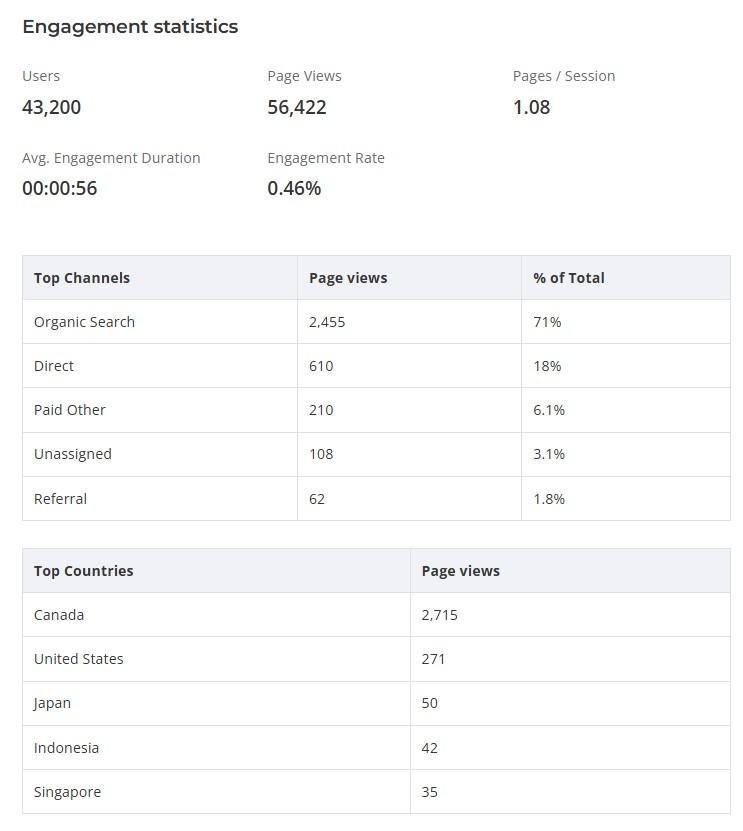
Figure 9. Seller-reported engagement statistics: 43,200 users at a 0.46% engagement rate and 56-second average sessions. Independent tools see ~9 organic visits/mo for the same site – a discrepancy the “Verified” badge does not resolve.
How this was caught: the seller’s reported traffic was checked against two independent estimation tools rather than taken at face value. A “Verified” badge confirms a GA property reports these numbers; it does not confirm the traffic is genuine. The reconciliation is the diligence step the marketplace check skips.
Finding 4: The Real Revenue Model Is Lead Generation, Not “Affiliate Sales”
Verdict: Listing label misleading. [Moderate confidence]
Inspecting the money path on the live site reveals two mechanisms running side by side, with the emphasis opposite to the listing’s framing.
Primary: lead generation
The prominent calls to action (“Become Debt Free,” “See if You Qualify”) do not send visitors to a lender. They route to the site’s own form subdomain (form.canadiandebtrelief.ca), which captures the visitor into a HubSpot/Brevo contact list – the mechanism behind the “1.7K contacts” and “partner deals” claims. The funnel is fronted by a persona (“Evelyn”) and qualifies the lead by debt amount.
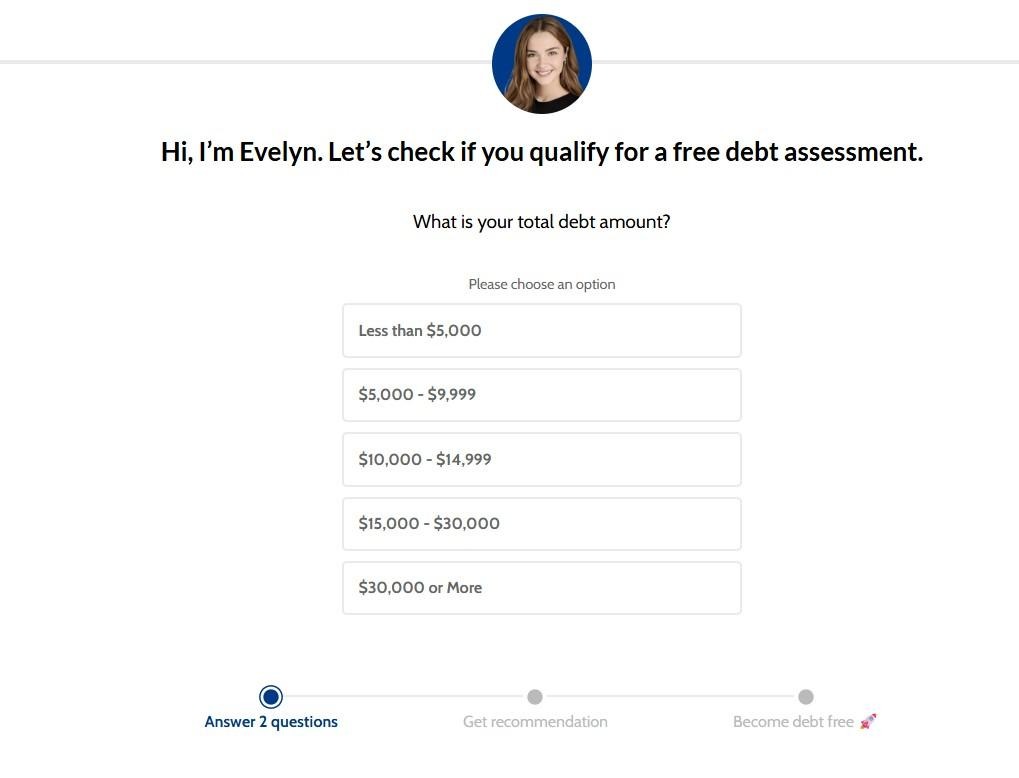
Figure 10. The lead-capture funnel on form.canadiandebtrelief.ca – the consistent, sitewide monetization mechanism. Leads are qualified by debt band, not referred to a lender via affiliate link.
Secondary: occasional affiliate redirects
Some in-text links route through an affiliate redirect. One observed link (“Bree Loans”) passes through cmi.rocks/go/… – a classic affiliate redirect – which resolves to CreditMarketing.ca, a Canadian finance affiliate network advertising “Canada’s Highest Paying Finance Affiliate Offers,” $300+ per qualified lead, CPL/CPF, and S2S postback tracking. Affiliate links of this kind were observed occasionally rather than systematically; the consistent monetization across pages is the lead-capture funnel.
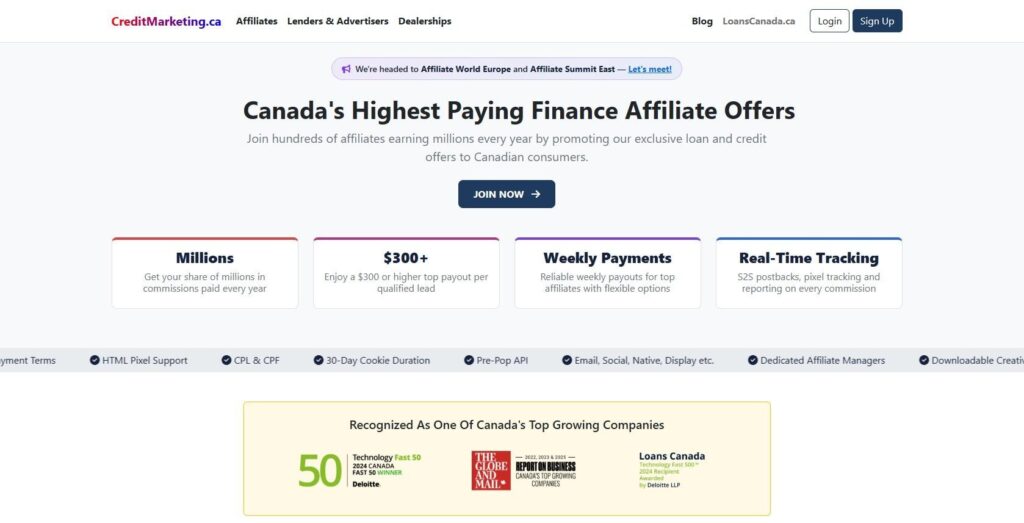
Figure 11. The affiliate redirect (cmi.rocks) resolves to CreditMarketing.ca, a Canadian finance CPL affiliate network. This confirms the affiliate component and its loan/credit vertical – consistent with the payday-loan review pages.
Why this matters: the listing’s “Affiliate Sales” label understates a lead-generation business. Lead-gen is more operator-dependent and less transferable than passive affiliate income – it relies on active relationships with lead buyers and on the deliverability of an existing list. A buyer told “affiliate site” acquires a different, more fragile business than described.
The revenue claim is contradicted by the listing’s own figures
The listing card headlines “$10.4K/yr.” The seller’s own Financial Statistics in the same listing report annual revenue of $7,634, and the month-by-month breakdown sums to approximately the same figure. The headline overstates the seller’s own documented revenue by roughly a third.
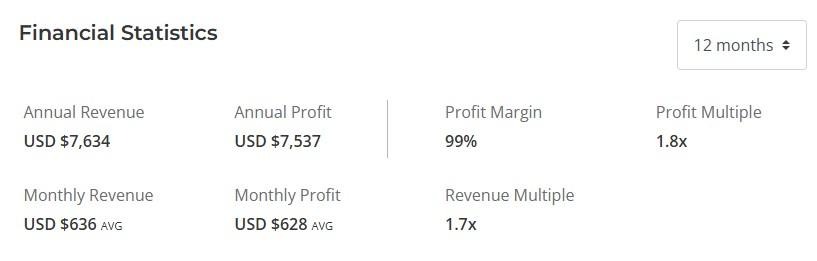
Figure 12. Seller’s Financial Statistics: annual revenue $7,634 / annual profit $7,537 – not the $10.4K/yr on the listing card.
Figure 13. The monthly breakdown sums to ~$7,632, corroborating the $7,634 figure and contradicting the headline claim.
The asset’s only residual value is an unverifiable list
This is the practical conclusion a buyer should not miss. Both monetization mechanisms require traffic the site no longer has (~9 organic visits/mo). Whatever revenue exists must originate from the existing contact list – not from the site’s current search performance. The asset is therefore not a content site with durable organic authority; it is, at most, a mailing list of unverifiable size and quality, offered at a content-site multiple. A buyer cannot confirm the list’s existence, size, consent status, or deliverability before purchase. Strip away the manufactured authority and the irreconcilable traffic, and that list is the entire thesis – and it is the one thing diligence cannot verify from outside.
How this was caught: the outbound links on the only trafficked pages were inspected by hand to separate the lead-capture funnel (the site’s own form subdomain) from affiliate redirects, and the headline revenue figure was checked against the seller’s own financial breakdown rather than accepted from the card.
Finding 5: The Authorial Expertise Could Not Be Corroborated
Verdict: Unable to determine (authority unsubstantiated). [Moderate confidence]
On a financial-advice site, author credibility carries real weight. The site presents a principal/author, “Marcus Chan,” with a claimed twenty-year institutional-finance background, and a separate funnel persona, “Evelyn.” Neither could be corroborated:
- Reverse image search on the Marcus Chan headshot returned no matches on TinEye and was restricted by policy on Google people-search – inconclusive either way.
- No independent footprint corroborating a “Marcus Chan” in this role was located.
- The recurrence of a “marcus” handle in the site’s own infrastructure (an EasyWP staging hostname surfaced during infrastructure analysis) is noted but not relied upon.
This is reported as an absence of verifiable expertise, not as proof of fabrication. The distinction matters: the claim that the personas are invented cannot be supported from open sources, but the claim that the site’s presented expertise is uncorroborated can. On a your-money-your-life financial site, that itself is a credibility finding.
Risk Synthesis
For an acquirer, the findings above translate into a concentrated set of risks. Each is rated by severity and grounded in the evidence already presented.
Search/penalty risk – HIGH
The majority of the referring-domain profile consists of spam-flagged, traffic-less domains acquired in the listing window, several resolving to a commercial PBN vendor. This profile is a disavow-or-penalty liability, not a durable authority asset. Critically, the site has no organic performance to lose (~9 visits/mo) – so the backlink profile offers no upside and only downside: it is the single largest risk to forward search performance.
Revenue durability/transferability risk – HIGH
Both monetization mechanisms require traffic the site no longer has. Any historical revenue must derive from a channel not visible to a buyer (the existing contact list, prior paid traffic, or direct relationships). Forward revenue therefore depends on the transferability of the 1.7K-contact list – unverifiable pre-sale and not guaranteed to survive a change of operator. The stated $10.4K/yr cannot be reconciled with the current organic profile.
Misrepresentation/claims risk – HIGH
Multiple headline claims do not survive verification. The listed “$10.4K/yr” revenue is contradicted by the seller’s own Financial Statistics in the same listing, which report ~$7,634 – an overstatement of roughly a third, from the seller’s own dashboard. The reported analytics (43,200 users) cannot be reconciled with independent tools (~9 organic visits/mo). The “two-year-old site” is a re-registered 12-year-old domain; the “119.5K AI mentions” figure is zero in every measured dataset; and the “affiliate sales” label describes what is primarily a lead-generation business.
Operator-dependency risk – MODERATE
A lead-generation business turns on active relationships with lead buyers and on list deliverability – both operator-held. The asset is more dependent on the departing operator than an “affiliate content site” framing implies.
Content-credibility risk – MODERATE
On a YMYL financial site, the presented authorial expertise is uncorroborated, and the only organic visibility is for high-interest loan products that sit against the site’s debt-relief positioning.
Net assessment. The asset sold for $13,338 at a 1.8x profit multiple. Its referring-domain authority was created during the listing window; its organic traffic does not reflect that authority; its reported analytics cannot be reconciled with independent tools; and its revenue model is lead generation dependent on a list a buyer cannot verify. Stated neutrally: the asset’s observable authority and traffic profile do not justify the claims made in the listing. The diligence question is answered.
Recommendation
A diligence report exists to inform a decision, so this case study states the recommendation a live client would have received.
Had this been live pre-acquisition diligence, our recommendation would have been to walk. The backlink profile carries downside and no upside; the reported traffic cannot be independently confirmed; the headline revenue is contradicted by the seller’s own figures; and the only residual value – the contact list – cannot be verified before purchase.
If a buyer wished to proceed regardless, the defensible structure would be: condition any offer on (1) transfer of the contact list, with consent status and deliverability evidenced by the seller, (2) a price that ascribes zero value to the existing backlink profile and search authority, and (3) a holdback or earn-out tied to post-transfer revenue actually materializing from the list. In practice, those conditions strip most of the asking price – which is the correct outcome when the documented value is largely cosmetic.
The broader point for an acquirer: the cost of this analysis is trivial against the loss it prevents. On this $13K asset the math is illustrative; on a $150K aggregator deal carrying the same pattern, it is the difference between a disciplined pass and a six-figure write-down.
What Could Not Be Determined
In keeping with the methodology, the limits of this investigation are stated explicitly. Each of the following was checked and could not be resolved from open sources:
- Who created or commissioned the manufactured links. The pattern and timing are established; responsibility is not. This report makes no claim on the point.
- Ownership continuity across the 2022–2023 gap. CIRA registrant privacy and identity-thin prior captures prevent determining whether the current operator is continuous with prior owners or acquired a lapsed domain.
- The actual revenue figure and its source. The mechanism is characterized; the dollar figure is not independently verifiable without seller data and depends on the contact list.
- Whether the author/funnel personas are fabricated. Corroboration is absent; fabrication is not proven.
- The literal meaning of “119.5K AI mentions.” The figure is not reproduced by any measured AI-visibility dataset; what the seller counted is unknown.
About This Work
Plumbline Intelligence produces forensic competitive intelligence and pre-acquisition diligence on digital businesses. The work combines SEO forensics with open-source intelligence to answer the questions a buyer cannot answer alone: whether a competitor’s advantage is earned or manufactured, who is actually behind an asset, and what risks are not visible on the surface.
This case study examines a real, publicly listed asset that has already sold. It is published for demonstration. Every finding is drawn from public sources – marketplace listings, third-party SEO tools, the Internet Archive, and the referenced parties’ own public storefronts – and is stated at the confidence the evidence earns.
If you are evaluating an acquisition, or trying to understand a competitor whose advantage doesn’t add up, this is the kind of analysis we do on engagement – before the wire goes out, not after. Start a conversation at plumblineintelligence.com.
Prepared by Plumbline Intelligence – Lasha Hetiia. Forensic competitive intelligence for digital business buyers.